Prepare existing records for the next task.
The platform in brief
Bring records together
aiomics brings the supplied case records together and makes documented information available for subsequent tasks.
- Text recognition for scanned documents
- Assign documents to the appropriate patient record
- Original sources alongside the prepared information
Reconcile information
Independent analyses and cross-checking help reveal differences and missing information in the records.
- Source references for review
- Notices of differences and omissions
- Drafts based on your hospital’s templates
Work together
The shared case view connects records, progress and responsibilities. Physicians, nursing, therapy and administration work on the same case.
- Manage referrals and admissions together
- Keep deadlines and responsibilities in view
- Record questions directly against the case
The overview organises cases by administrative criteria. Clinical assessment, urgency assessment and approval remain with the responsible professionals.
Where aiomics fits into your existing landscape
Aiomics processes the documents you provide for a case. The shared overview connects structured information with the original records.
During review, trace information to its source, examine differences between documents and address missing-information notices.
Selected sources support further documentation tasks: admission reports, discharge letters, applications or responses to payer enquiries. Templates define structure and requested information.
You determine where aiomics fits into your workflow and how reviewed results are used.
Compare information and check omissions
Source comparison examines multiple structured representations of the same documents for differences and missing information.
Notices and related sources support your team’s review. Documented information remains distinguishable from professional additions; responsible staff resolve unclear points.
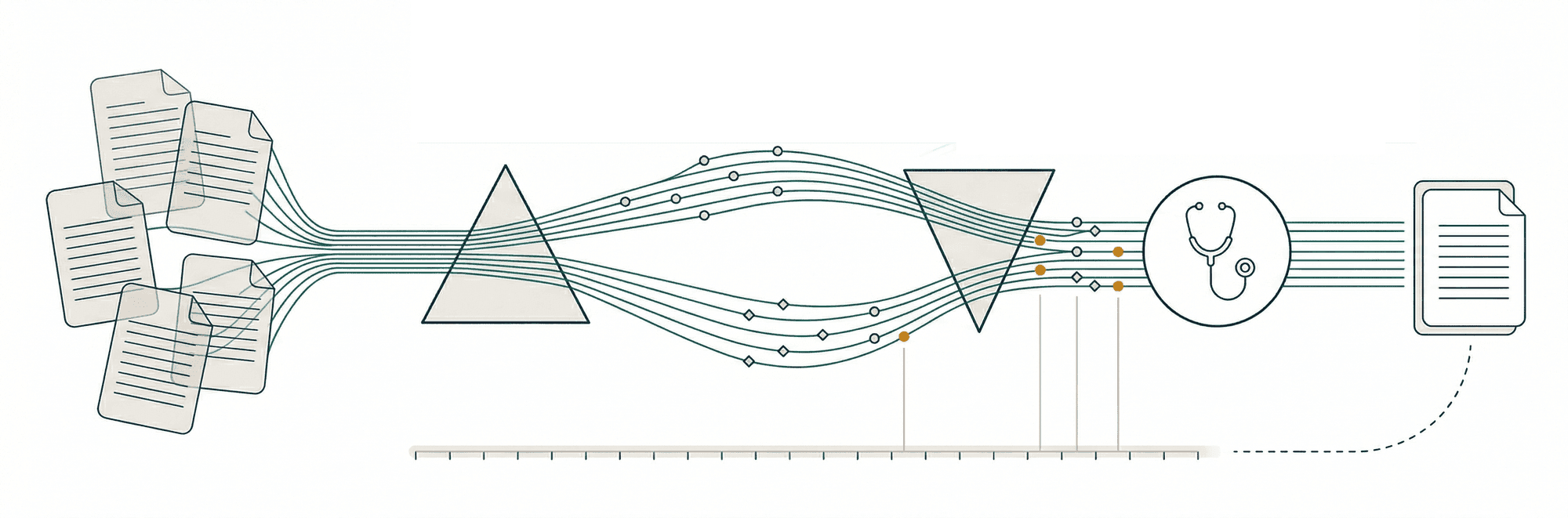
Two independent analysis agents
Two AI agents process the same source documents independently. Each creates its own structured summary.
Systematic cross-reconciliation
A third agent compares both summaries specifically for discrepancies and missing information.
Synthesis
A fourth agent evaluates the discrepancies found, creates the final structured overview, and clearly marks where source documents diverge.
Source references
Source references connect structured information with original documents. Open the supporting passage and review the statement in context.
Inspect the workflow with an example case: open a supporting passage, follow a differing account and check an omission notice.
The comparison concerns documentation. Medical assessment and professional decisions remain with the responsible people.
What we hold this design to
- 50–82 %
Six language models were given 300 physician-validated case vignettes, each containing one fabricated detail: a laboratory value, a physical finding, or a condition. Depending on model and prompt, the models elaborated on the fabricated detail in 50 to 82 percent of cases. A prompt written specifically to prevent this lowered the mean from 66 to 44 percent.
Source: Omar M, Sorin V, Klang E et al., Communications Medicine 2025;5:330
- below 50 %
More than 27,000 diagnosis and procedure codes were drawn from twelve months of routine care. The models were handed the official description of each code and asked to name the code. Every model tested stayed below 50 percent correctly reproduced codes.
- 75.3 %
In a survey of 2,207 care workers across 118 facilities, 75.3 percent rated filling in the resident's health record as a strong or rather strong burden — more often than any other administrative task. A higher administrative load went together with higher odds of intending to leave the profession (OR 1.24; 95% CI 1.02–1.50).
- The counter-finding we name ourselvesn.s.
The same study finds no significant association with emotional exhaustion in the fully adjusted model (OR 1.22; 95% CI 0.98–1.52). What less administrative work does for exhaustion remains open. The association with the intention to leave the profession is the one that holds.
Source: Ausserhofer D et al., BMC Geriatrics 2023;23:347, fully adjusted model
That is why reconciliation comes before generation at aiomics: two independent analyses, a cross-check against the original document, a consolidation — and physician approval at the end.
Everything you need. In one place.
Intake and reading
- Bulk uploadEntire record stacks for several patients in one operation
- Text recognitionScanned and photographed pages become machine-readable
- Document splittingBundled transmissions are separated into individual documents
- Patient matchingA proposed record match, confirmed by a person
- Data-quality checkingFlags illegible pages, missing attachments, and contradictory entries
- Source viewOriginal document and processed version side by side
- DictationPilotVoice input directly in the field, with a correction step
- Fax intakeon requestDigital fax reception straight onto the board
- Lab connectionon requestFindings via LDT and HL7 directly into the record
Reconciling and evidencing
- Integros reconciliationTwo independent analyses, cross-check, consolidation
- Source referencesEvery entry points to a document and a page
- Divergence flagsWhere sources contradict each other, the result says so
- Gap flagsMissing mandatory entries are marked before submission
- Draft markingUnverified AI entries are visually set apart
- Express modeplannedA shortened run for routine cases, with the approval duty unchanged
- TimelineplannedThe course of the case across all available documents
- Lab valuesplannedOrgan groups, reference ranges, trends
- Medication overviewplannedConsolidated from every available source
Working as a team
- Admission boardIncoming referrals from enquiry through to admission
- Case card on your own termsPer patient, the fields your hospital has defined: travel distance, payer, referring practice, registered care needs, notes from the documents such as multi-resistant organisms
- Bed-management boardBed and appointment planning in the same system
- Preliminary and payer dialogue boardPayer correspondence with deadlines and status
- Role viewsEach profession sees the columns its work requires
- OwnershipEvery card has one responsible person
- CommentsQueries stay on the card, linked to the case
- Change historyTraceable record of who changed what and when
- Discharge boardplannedDischarge as its own board configuration
Writing and documenting
- Report draftsPhysician letters, admission findings, progress notes
- Template libraryMore than 100 templates for rehabilitation and acute care, cut to your hospital's own documents and workflows
- Personal styleDrafts follow the physician's own way of writing
- Form completionProposed field content drawn from the record on file
- Rehabilitation reporting (DRV)Discharge reports and extension requests for the German pension insurance
- Payer letters (statutory and private)Correspondence with statutory and private payers, every passage with its source
- Complex treatments and OPSProgress and evidence documentation against the minimum criteria, flagging what is missing
- Patient letterA plain-language version for patients
- Expert opinionsPilotTemplates for medical expert reports
- Encounter documentationPilotStructured drafts from recorded conversations
- House template (.docx)plannedOutput directly on the hospital's own letterhead
Protecting revenue
- Preliminary and payer case dialoguesReply drafts with a source trail from the record
- Medical Service review proceedingsContesting, discussion and litigation stages in one place
- Deadline trackingDeadlines under the audit procedure agreement (Prüfverfahrensvereinbarung) in view
- Coding notesNotes on ICD-10-GM and OPS based on what the documents contain
- Extension requestsReasoning drawn from the documentation on file
- Private-fee codingplannedProposed items for private billing, each with its source passage
- Private-fee checkingplannedExclusions, reductions and multipliers through fixed rules
- Case-law referencesplannedPointers to the relevant decisions
- § 301 data checkplannedChecking the data before the hospital system transmits it
Involving patients and referrers
- Questionnaires and surveysYour own instruments for patients, relatives and staff — at the bedside, at home, or on paper
- Admission questionnairesPilotStructured information ahead of the appointment
- Measurement wavesPilotMeasurement points by calendar or by admission and discharge
- Patient portalplannedDocuments, appointments, and forms for patients
- Referrer portalplannedReferring practices submit documents digitally
Quality and management reporting
- PROM and PREM analysisplannedAdmission-to-discharge comparison at group level, with case count and completeness
- Subgroup analysisplannedBreakdown by indication group, department, ward, quarter and payer
- Trend chartsplannedDevelopment across quarters, with control limits for ordinary variation
- Referrer analysisplannedOrigin of enquiries, turnaround time and admission rate per referring practice
- Occupancy and turnaroundplannedOccupancy and processing times at team level
- Quarterly and management reviewplannedDrafts along the requirements of the federal quality directive and ISO 9001
- Minimum group sizeplannedSubgroups below the minimum stay hidden, with a note that they were suppressed
- Staff surveys and incident reportingplannedAn anonymous channel, reports on near-miss events
- Structural audit dossierplannedEvidence for the structural audit under § 275a SGB V
Security and traceability
- EU processingProcessing and storage exclusively within the European Union
- ISO/IEC 27001Certified by TÜV NORD
- Roles and permissionsAccess by function and by area
- Approval requirementNo AI output enters the record without physician approval
- AI labellingMachine-generated content is marked as such
- Audit logPilotSystem-side logging of every action
Connecting and getting started
- Browser operationNo installation, no maintenance for your IT
- HL7 v2Connection to existing systems
- FHIR R4Structured data exchange
- ISiKThe German interoperability standard for hospitals
- Folder monitoringA watched directory as the simplest way in
- Scanner connectionExisting scanners deliver straight into the record
- Onboarding portalA protected portal that guides the internal project lead through the five phases of a rollout — free for customer hospitals
- Rollout materialReady-made documents for every phase, from the invitation to the executive board to the works council briefing
- Fax intakeon requestDigital fax reception via a cloud service
- Lab connectionon requestLDT 3.0 for findings and orders
Unmarked: in production use at customer hospitals. “Pilot”: under trial at individual hospitals. “on request”: available, with effort and price set by your systems landscape. “planned”: specified, not yet in use.
What comes next
Inpatient documentation
Daily progress documentation on the ward, every day in the same tool — so the record is complete on the day of discharge.
Discharge management
Discharge as its own workflow on the board: responsibilities, deadlines, completeness checks. Discharge letters are already produced today as source-based drafts.
Quality management
Group-level analysis of your own surveys, plus the reports the federal quality directive, the rehabilitation framework agreement and ISO 9001 ask for.
Operational analytics
Occupancy, turnaround times, admission rates and referrer origin — at team level, with a minimum group size enforced in code.
Outcome analytics
Admission-to-discharge comparisons from validated questionnaires, broken down by indication group and department.
Planned capabilities are marked as such on this page. We do not name dates before they hold.
See quality managementModules in Detail
Coordinate admissions and referrals
Admission management shows current referrals and planned admissions in a shared case view. The platform extracts and structures recorded information and flags missing documents. The team can organise cases by arrival date, workflow status, and responsibility, and prepare follow-up requests.
Documents and follow-up requests in one place. The admissions team can see each case’s status; the responsible professionals make the clinical assessment and admission decision.
Patient overview with access to sources
Betaaiomics creates a chronological, structured overview based on all available documents. Diagnoses, medication, findings, allergies, and lab values are extracted and reconciled. Where documents diverge, it becomes visible — with direct access to the originals.
Review structured information together with original sources. Difference and omission notices support checking.
Data overview — no clinical assessment. Source documents accessible via the document icon.
Prepare letters and reports using your templates
The platform creates draft medical letters and reports from the patient overview. Structure and formatting follow your templates. Source references help reviewers check the extracted information. Physicians complete and approve the draft.
An editable draft with source references, omission notices and the required report structure. Professional review remains part of the workflow.
AI draft — physician review and approval required.
Handle payer enquiries using the existing record
The platform prepares payer-response and application drafts from existing documentation. Responsible professionals check evidence, reasoning and procedural context.
The information used and its sources are available for review. The hospital approves and sends the response.
Processing uses documented facts. Specific checks of German procedure-code requirements and further procedural automation are planned.
Prepare forms and applications from existing information
Betaaiomics generates suggested form content based on the patient overview. Before submission, missing required fields are flagged. When the payer follows up, relevant source information is already structured and ready.
The form draft and its source records are available together for review and completion.
Completeness hints — no medical recommendations.
Define the handoff into existing systems
Integration starts with the specific task: which documents arrive, which information is needed and which system receives the work?
The application runs in a browser. A defined use case can start with supplied documents; setup includes access rights, data protection and organizational requirements.
For a direct connection, review the input channel, data fields, output format and destination system. Individual interfaces depend on the system and agreed scope.
The trial also covers confirmation, corrections and transfer exceptions, making automated and staff-operated steps visible.
Want to see how aiomics works with your documents?
Explore the PlatformNo-obligation demonstration — with your own documents if you like.