IMPLEMENTATION AND ENABLEMENT

Any hospital can buy the tools. The advantage has to be earned.

We have used digital systems in hospitals, built them, and rolled them out — and today we build AI ourselves for one of the most tightly regulated environments there is. What we have learned along the way, we pass on: to leadership teams, to project leads, to everyone who has to decide which vendor to believe.
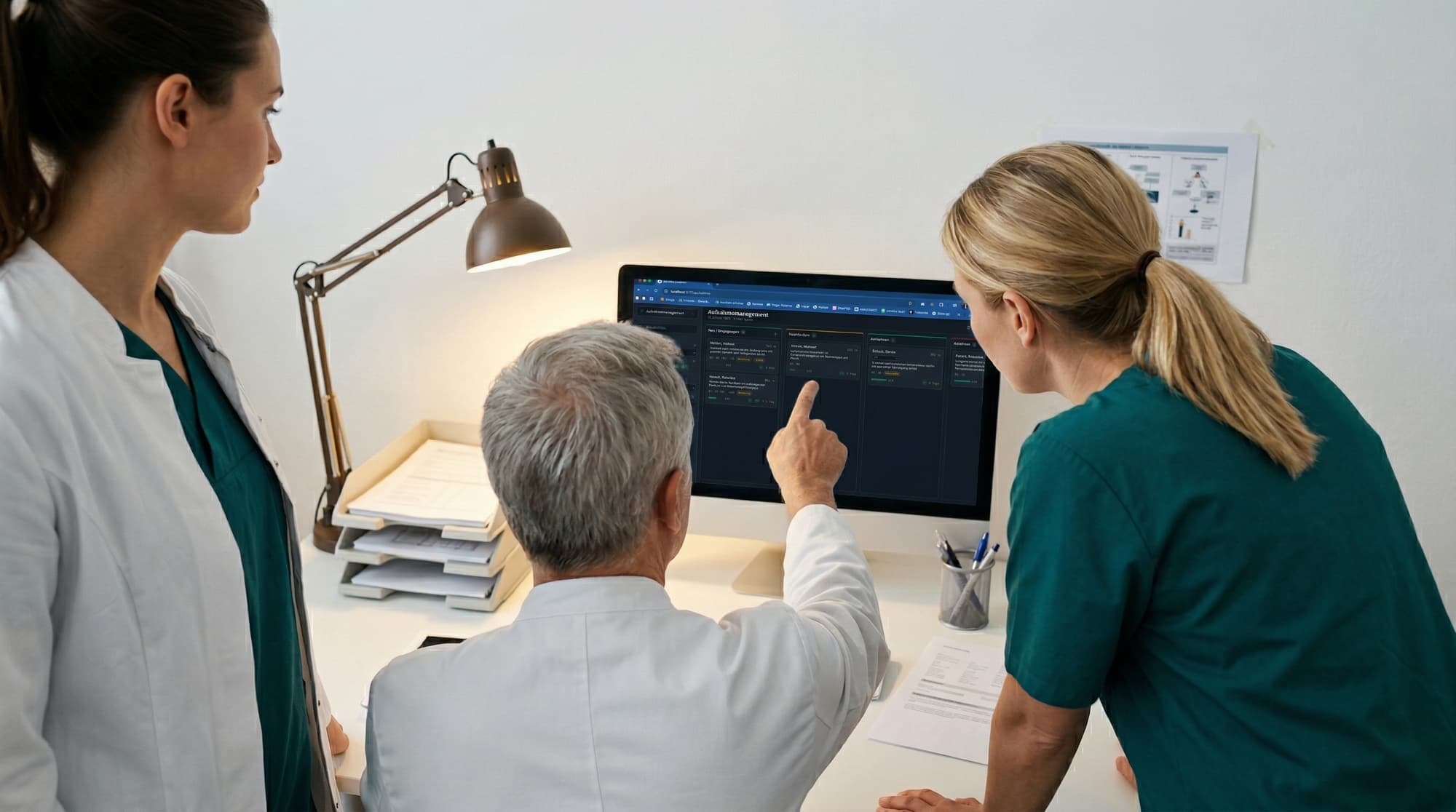
Two physicians and a nurse reviewing an admission board on screen together

The distance between use and return

The figures are remarkably stable across industries: almost everyone uses AI, almost nobody earns from it. In a hospital there is the added fact that a mistake costs more than money.
88%of organisations report regular AI use in at least one business functionMcKinsey, The State of AI, November 2025
6%report a substantial earnings contribution — more than 5% of operating profitMcKinsey, The State of AI, November 2025
23%of companies in Germany have established rules for the use of AI toolsBitkom Research, October 2025 (604 companies with 20+ employees)
Article 4AI literacy among staff is a deployer obligation — in force since 2 February 2025Regulation (EU) 2024/1689 (EU AI Act)

The distance between the 88 and the 6 per cent is not in the model. It is in the work before and after: which workflow gets rebuilt, who answers for the result, what gets measured. That is the work we do with you.

The same workflow, built twice
Bolted on
AI tool
  1. collect documents
  2. check by hand
  3. decide
  4. document

Nothing changed place. The invoice arrives regardless.

Rebuilt
AI and sign-off inside the workflow
  1. documents arrive
  2. checked, structured, signed off
  3. decided — earlier
  4. documentation forms alongside

A decision moved forward. A number measures it, a person answers for it.

The difference between an expensive purchase and an advantage appears where a decision changes its place.

How we know this

We know what it takes to introduce a digital system from every seat around the table: from the ward, where you work with software somebody else selected; from development, where that software is built; and from the leadership of a hospital group's digital company, where selection and rollout are decided.

Today we run AI where an incomplete record shapes a course of treatment. Our platform checks every statement against the source document before a human signs it off. What we tell you about oversight, evaluation and sign-off, we learned on our own product and in the hospitals that use it.

There is a second origin here that is rare in this field: medicine and evidence-based practice. We assess a method the way one assesses a study — by asking what the evidence carries and where it stops.

A physician who used the systems

Sven Jungmann worked in hospitals — and worked there with software somebody else had chosen. Alongside that: a medical degree, a Master of Public Policy at Oxford, and a Master of Public Health at the London School of Hygiene & Tropical Medicine.

On the hospital's side of the table

He has built digital solutions himself and was Chief Medical Officer of the first digital company of one of Europe's largest hospital groups. Selection, rollout, resistance inside the building — we know those questions from the seat where they have to be answered.

Certified for ISO/IEC 42001

Sven Jungmann is TÜV-certified for AI management systems under ISO/IEC 42001 — the international standard increasingly asked for in tenders.

ISO 27001 certified

aiomics is ISO 27001 certified (TÜV Nord), with processing exclusively in the EU. Years of building systems in which data protection, traceability and resilience are the foundation — we know the audit from the perspective of the party that passes it.

Independently evaluated

The accuracy of our methods is being evaluated independently at the Charité. How to set up an evaluation like that is part of what we pass on.

A network that holds

Over the years a circle of experienced specialists in AI, data science and machine learning has grown up around us. For work outside our own field we can usually name someone who is good at it.

Four formats

Each can be booked on its own, and they build on one another. What fits you is something we settle in the first conversation — often it is less than you expect.
01

Leadership session

Scope
Half a day · on site or online
For whom
Executive management, medical and nursing directors, head of IT, medical controlling

A session after which your leadership team speaks the same language. How a language model works and why it can be convincingly wrong. What the EU AI Act asks of a hospital and what it does not. How a good implementation can be told from a bad one. We work from examples in your own hospital.

What you hold afterwards

A self-diagnosis across six dimensions, completed in the room · a shortlist of the workflows worth rebuilding first · minutes with named owners

What changes afterwards

Your leadership team can ask vendors the questions that weak offers fail.

Enquire about this format
02

Multi-week programme

Scope
6 to 12 weeks · online material and in-person sessions · one cohort from your hospital
For whom
Department heads, senior physicians, nursing leads, medical controlling, quality management, IT

This programme ends in a rebuilt workflow. Participants work on a real project from their own area — one that matters to them personally. Between sessions we accompany the work; in the sessions it is put to the test.

What you hold afterwards

Online modules on how the technology works, evaluation, oversight and data law · fortnightly working sessions · one results report per project, with a baseline and an end value

What changes afterwards

A workflow that demonstrably holds — and a handful of people who can build the next one without us.

Enquire about this format
03

AI governance structure

Scope
4 to 8 weeks · stocktake, draft, handover
For whom
Executive management, data protection, IT security, medical director, quality management

For a hospital to answer for its use of AI, three things have to exist: an overview of where it is being used at all, clear responsibilities, and rules that survive contact with the working day. We build that structure with you — oriented on ISO/IEC 42001, the international standard for AI management systems, and at the depth that fits your hospital. In most hospitals, incidentally, the overview begins with the private use that is already happening without anyone having authorised it.

What you hold afterwards

A stocktake of the AI in use across the hospital · one page of usage rules · a risk register with one named owner per entry · responsibilities and decision paths · a classification of your applications under the EU AI Act · evidence of AI literacy under Article 4

What changes afterwards

You know where AI is running in your hospital, who answers for it, and who is allowed to stop it.

Enquire about this format
04

Vendor scrutiny before procurement

Scope
1 to 4 weeks · per procurement, or as a standing framework
For whom
Procurement, head of IT, data protection, medical controlling, the department concerned

A polished demonstration is the weakest evidence of a working product: it was built from the cases in which the technology shines. We give you the checklist that lets you judge an offer before it has ever been tested in your hospital — for specialised clinical vendors as much as for the general-purpose assistants like ChatGPT or Claude that are already in use across many hospitals. If you want to look closer later, you test against a set of real cases from your own hospital; we build that with you too.

What you hold afterwards

A procurement checklist, separated for specialised solutions and for general-purpose assistants · a criteria catalogue for the tender and the award · a question catalogue for vendor meetings · one assessment report per vendor

What changes afterwards

You know what you are buying while others are hoping.

Enquire about this format

How we work

1

Start with one workflow

Large AI initiatives and impressive pilot projects fail in the same way. We begin with a single workflow: one that occurs often, is tiresome enough to be worth the effort, and whose result can be measured.

2

One number, one name

Two things are fixed before the start: the number by which you will read, in three months, whether it held, and the person who answers for the operational result. A risk nobody owns does not get handled.

3

The works council from the outset

Where jobs are touched, the works council belongs at the table before the decision is made. It costs lead time and saves more. Presenting a committee with a finished decision earns resistance.

4

An honest ending is allowed

If the case does not hold after twelve weeks, we say so. An honest stop is cheaper than any continuation of the wrong thing — and it teaches more about the second case than a flattering report would.

What we do not take on

  • Procurement law. That needs lawyers. We supply the substantive criteria that belong in the documents.
  • Certification. We prepare and accompany; the certificate is issued by an accredited body.
  • Referrals for commission. We take money from no vendor for a recommendation.

Where we do not take a task on, we can usually name someone who is good at it.

Who does this

The formats are led by Dr Sven Jungmann, physician and founder of aiomics.

For larger engagements we work with a settled circle of experienced specialists in AI, data science and machine learning, and with partner firms for questions outside our own field.

Whoever works on your engagement is named in the proposal — with their role and their share of the work.

Frequently asked questions

Do we have to use the aiomics platform to work with you?

No. The formats stand on their own, and some of our clients do not use our software. We do of course hope you like working with us. If it turns out along the way that our platform fits your hospital, we will say so — and if it does not, equally.

You are a vendor yourselves. How do you handle that?

Openly. We do not audit as independent assessors and we do not present ourselves as such. What we bring is the view of people who build and run AI for hospitals themselves — and who know the questions a vendor would rather not be asked. We take money from no vendor for a recommendation. Where aiomics is a candidate for your hospital, we apply the same criteria to it as to any other solution.

What does it cost?

That depends on the format, the duration and the number of people involved. We name the price after the first conversation, once we have established what you actually need. It is often less than expected: a leadership session is not a consulting engagement.

How quickly can we start?

A leadership session can usually be scheduled within four weeks. For the longer formats we plan six to eight weeks of lead time, because choosing the first workflow and taking the baseline measurement are part of it.

We already have a digital strategy. Does this fit?

Usually, yes. Hospitals with a strategy rarely fail on the strategy. They fail on the first workflow that actually gets rebuilt, and on the question of who answers for the result.

What does the EU AI Act require of us as a hospital?

As a deployer your list is shorter than the provider's: use the system according to its instructions, assign competent human oversight, monitor operation, report serious incidents, retain logs, and inform those affected. Since 2 February 2025 every deployer must also ensure that staff have a sufficient level of AI literacy (Article 4). Most applications in a hospital are not high-risk — the sober classification comes at the beginning.

Do our physicians earn continuing-education credits?

For AI literacy under Article 4 there is a certified online course carrying 3 CME credits from the Hesse chamber of physicians (Ärztekammer Hessen), endorsed by the Marburger Bund and the German Society of Internal Medicine (DGIM), among others. It can be attached to any of the formats.

Do you work outside Germany?

Yes — across the German-speaking countries and, beyond that, in the wider European context. The formats are available in German and in English.

The first step is a conversation, not a proposal.

Arrange a conversation

30 minutes with Sven Jungmann. After that you will know whether we are a fit.