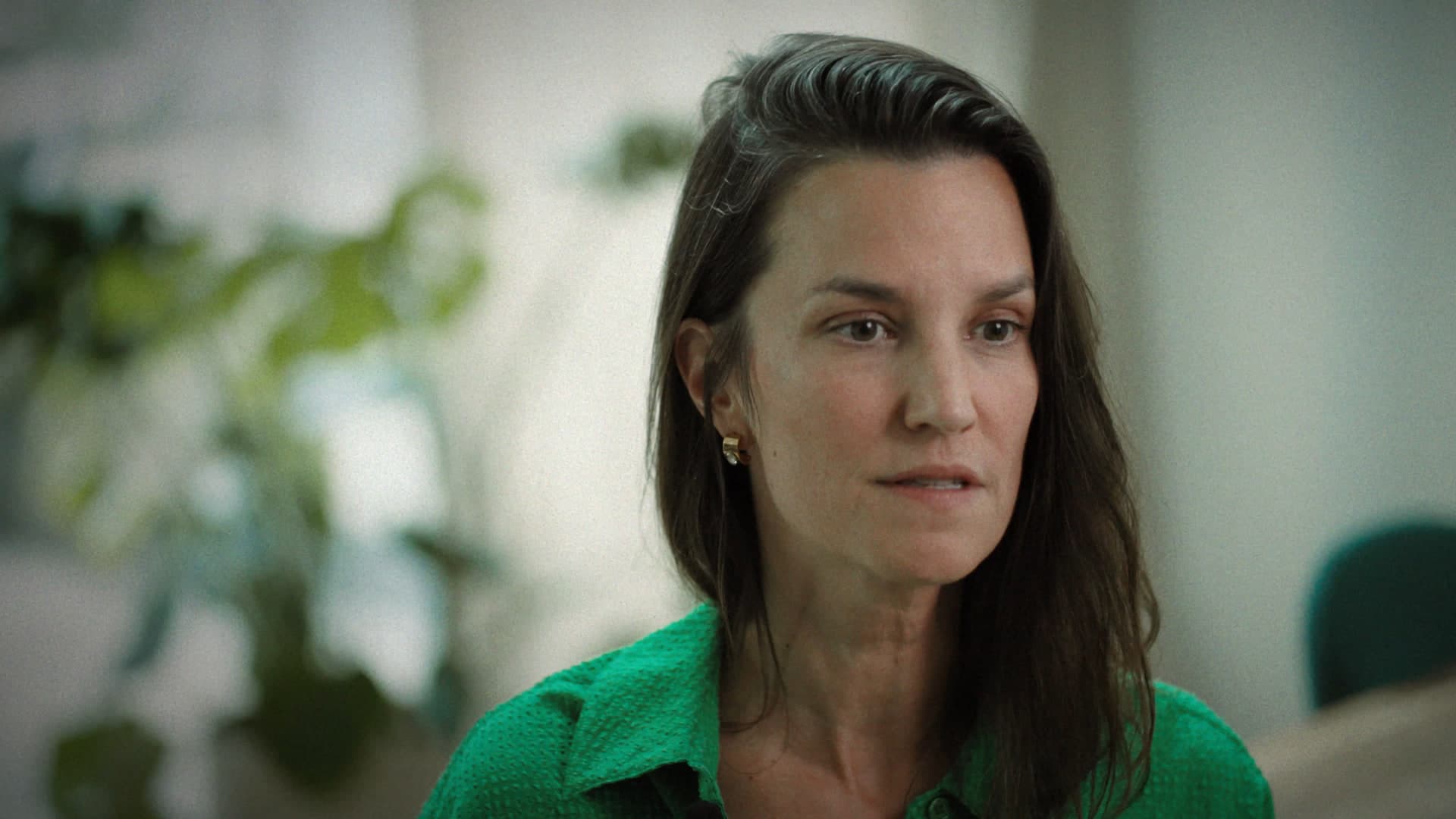
A documentary, four minutes
Valerie's Story
A paediatrician tells why she left medicine. And why her colleagues rarely say so out loud.
The film is released on 8 October 2026, two days before World Mental Health Day, in German and English. Press, medical associations and physician-health programmes receive a preview link from 1 October.
Directed by Jasper Claus · Produced by 1camera, Amsterdam · Commissioned by aiomics, Berlin

The story
Valerie Kirchberger wanted to be a doctor since she was a child. Her mother was a psychoanalyst and told her early that there were people who were only alive because she worked with them. Valerie wanted that kind of impact.
She became a paediatrician. Her first two years, in a neonatal intensive care unit in Munich, were the work she had dreamed of: well organised, real time with the smallest patients you can imagine, saving lives in emergencies. Then she moved to one of Germany's most prestigious university hospitals, and with it into a different job. Less than a tenth of her day was spent with patients. The rest went to documenting, logging and defending every step for someone who would read the record later and had never been in the room.
In the film she describes a night on call as two jobs at once: keep the children alive, and write every step down without a single mistake. She stopped sleeping between shifts. Sleeping pills in the hardest weeks first, then more often, then with wine, because the pills alone did not quiet her head. One afternoon at twelve she set an alarm for five hours to sleep before a night shift, and woke up vomiting.
"My dream had always been to become a doctor. But in that moment I realised: I can't be a good doctor anymore."
In 2017 she left clinical medicine. She says she did not walk away; she fell out. The exhaustion went, the anxiety, the pills. What stayed was emptiness, because she had left behind the one thing she wanted more than anything: sitting across from a person who needs help, and being able to give it.
She is well today. She has founded a health company, Evela Health, and has four children. And she thinks about it every day.
"Twenty percent instead of ten, and it would have been the most rewarding job in the world. I would never have left."
Why we made this film
I am a physician. I left the wards for the same reasons Valerie did. I wanted to help people, and I spent my days chasing faxes and writing down what I had done, for someone who would read it later with a coffee in hand and no idea what that night had been like. Whatever isn't documented didn't happen. That sentence hangs over every shift.
When I met Jasper Claus, who builds his films around the moment a viewer is moved, I wanted to tell this story with him. The real story began afterwards. It took us the better part of a year to find one doctor willing to say this on camera with her name attached. Many wanted to. Almost all concluded it would end their careers. A psychotherapist told us she had considered specialising in doctors' mental health and decided the culture was not there yet.
Roughly half of physicians in the large surveys report symptoms of burnout. Almost none say so in public. That gap is the stigma. Valerie closed it for four minutes, and we are grateful to her.
We made this film so that the people who decide about hospitals hear one of the people behind the numbers. Politics speaks in numbers; the people behind them rarely get to speak. The film shows no product and sells nothing. If technology is to help here, it has to be safe, checked, evidence-based and in service of what makes a doctor a doctor. The film is about why that matters.
Dr. Sven Jungmann, physician, co-founder of aiomics

The numbers behind the story
Valerie's "less than ten percent" is her experience. The studies and surveys show how many of her colleagues share it. Peer-reviewed studies and professional-body surveys are labelled separately; all sources are listed below.
1.7 hours
Time per day that internal-medicine residents at a Swiss university hospital spent with patients. At the computer: 5.2 hours.
Wenger et al. 2017, Annals of Internal Medicine (peer-reviewed time-motion study)
27 percent
Share of working time in direct contact with patients for physicians in US ambulatory practice. On records and desk work: 49 percent.
Sinsky et al. 2016, Annals of Internal Medicine (peer-reviewed time-motion study)
3 hours
Documentation per hospital physician per day in Germany, 37.5 percent of an eight-hour day, the equivalent of about 66,300 physician posts.
German Hospital Institute for the German Hospital Federation, September 2025 (survey of 400 hospitals)
28 percent
Share of employed physicians in Germany considering leaving patient care altogether. Among doctors in specialist training: 33 percent. Lack of time for patients is named as a reason by 52 percent of them.
Marburger Bund, MB-Monitor 2024, 9,649 respondents (member survey)
45.2 percent
Share of US physicians with at least one symptom of burnout in 2023. The peak, in 2021: 62.8 percent.
Shanafelt et al. 2022 and 2025, Mayo Clinic Proceedings (peer-reviewed national series)
13 percent
Share of doctors and nurses in the EU, Iceland and Norway reporting suicidal thoughts; 30 percent report depressive symptoms. 90,171 respondents.
Mediavilla et al. 2026, The Lancet Regional Health – Europe (peer-reviewed)
1.76
The suicide rate of women physicians relative to women in the general population.
Zimmermann et al. 2024, BMJ (meta-analysis, 20 countries)
21.4 percent
Share of US women physicians who met criteria for alcohol abuse or dependence. Among men: 12.9 percent.
Oreskovich et al. 2015, The American Journal on Addictions (peer-reviewed)
Nearly 40 percent
Share of US physicians who would be reluctant to seek mental-health care because of questions on licensing forms.
Dyrbye et al. 2017, Mayo Clinic Proceedings (peer-reviewed)
Almost one in four
23.8 percent of physicians in a large 2020 US survey intended to leave their practice within two years.
Sinsky et al. 2021, Mayo Clinic Proceedings: Innovations, Quality & Outcomes (peer-reviewed)
10 to 11 million
The shortfall of health workers worldwide that the World Health Organization projects for 2030.
WHO; Boniol et al. 2022, BMJ Global Health
From 35 to 6 percent
The share of doctors on full-time sick leave one year after counselling in Norway's Villa Sana programme. There are ways back.
Rø et al. 2008, BMJ (cohort study)
What would help
The film gives a simple answer: more of the day with patients, and a profession in which you can say you are not well without fearing for your licence. Both are work on the system. Technology can take over part of the administrative day; the evidence is early and mixed, and machine-generated clinical text contains errors that people have to check. Hence the rule: safe, checked, evidence-based, or not at all.
Sources
- Wenger N et al. Allocation of Internal Medicine Resident Time in a Swiss Hospital. Ann Intern Med 2017;166:579–586. https://doi.org/10.7326/M16-2238
- Sinsky C et al. Allocation of Physician Time in Ambulatory Practice. Ann Intern Med 2016;165:753–760. https://doi.org/10.7326/M16-0961
- German Hospital Institute / German Hospital Federation. Bureaucratic burden in hospitals, flash survey, 26 September 2025. https://www.dkgev.de/fileadmin/Mediapool/1_DKG/1.7_Presse/1.7.1_Pressemitteilungen/2025/2025-12_Buerokratiebelastung_im_Krankenhaus_-_Blitzumfrage.pdf
- Marburger Bund. MB-Monitor 2024, summary of results, February 2025. https://www.marburger-bund.de/sites/default/files/files/2025-02/MB-Monitor%202024_Zusammenfassung_Ergebnisse_0.pdf
- Shanafelt TD et al. Mayo Clin Proc 2022;97:2248–2258. https://doi.org/10.1016/j.mayocp.2022.09.002Shanafelt TD et al. Mayo Clin Proc 2025;100:1142–1158. https://doi.org/10.1016/j.mayocp.2024.11.031
- Mediavilla R et al. Working conditions and mental health among doctors and nurses in the European Union, Iceland, and Norway. Lancet Reg Health Eur 2026;69:101809. https://doi.org/10.1016/j.lanepe.2026.101809
- Zimmermann C et al. Suicide rates among physicians compared with the general population. BMJ 2024;386:e078964. https://doi.org/10.1136/bmj-2023-078964
- Oreskovich MR et al. The prevalence of substance use disorders in American physicians. Am J Addict 2015;24:30–38. https://doi.org/10.1111/ajad.12173
- Dyrbye LN et al. Medical Licensure Questions and Physician Reluctance to Seek Care. Mayo Clin Proc 2017;92:1486–1493. https://doi.org/10.1016/j.mayocp.2017.06.020
- Sinsky CA et al. COVID-Related Stress and Work Intentions in a Sample of US Health Care Workers. Mayo Clin Proc Innov Qual Outcomes 2021;5:1165–1173. https://doi.org/10.1016/j.mayocpiqo.2021.08.007
- WHO, Health workforce. https://www.who.int/health-topics/health-workforceBoniol M et al. BMJ Glob Health 2022;7:e009316. https://doi.org/10.1136/bmjgh-2022-009316
- Rø KE et al. Counselling for burnout in Norwegian doctors: one year cohort study. BMJ 2008;337:a2004. https://doi.org/10.1136/bmj.a2004
- Asgari E et al. A framework to assess clinical safety and hallucination rates of LLMs for medical text summarisation. npj Digit Med 2025;8:274. https://doi.org/10.1038/s41746-025-01670-7
If this is close to home
If you are a doctor and this film is close to home: you are not alone, and there are people who know the profession and whom you can talk to.
- United Kingdom
- NHS Practitioner Health (confidential service for doctors)
- Doctors in Distress
- BMA counselling and peer support 0330 123 1245
- Samaritans 116 123
- Ireland
- Practitioner Health Matters Programme
- Samaritans 116 123
- United States
- Physician Support Line 1-888-409-0141
- 988 Suicide and Crisis Lifeline
- Canada
- 988
- provincial physician health programmes via the Canadian Medical Association Wellness Hub
- Australia
- Drs4Drs 1300 374 377
- Lifeline 13 11 14
- New Zealand
- 1737, call or text
- Doctors' Health Advisory Service
- South Africa
- SADAG 0800 456 789
- Healthcare Workers Care Network
- Netherlands
- 113 Zelfmoordpreventie 0800 0113
- KNMG ABS-artsen
- Norway
- Villa Sana, Modum Bad
- Mental Helse 116 123
- Sweden
- Mind Självmordslinjen 90101
- Denmark
- Livslinien 70 201 201
- Germany, Austria, Switzerland
- Telefonseelsorge 0800 111 0 111 (DE)
- Telefonseelsorge 142 (AT)
- ReMed 0800 0 73633 and Die Dargebotene Hand 143 (CH)
Numbers last checked on 11 September 2026. Programmes missing here, please write to sven@aiomics.io.

Thanks
This film belongs to Valerie Kirchberger, who tells her story in her own words and puts her name to it. We thank Jasper Claus and the 1camera team in Amsterdam, who listened before they filmed. We thank Tamara Radakovic and Hendrik Steenfadt, who appear alongside Valerie. We thank the team of the simulation centre of a Berlin university hospital, who opened their doors to us. And we thank the physicians who spoke with us and decided against the camera. We understand. The film is for them too.
For press, associations and teaching
From 1 October 2026, press, medical associations and physician-health programmes receive a private preview link, embargoed until 8 October, 08:00 CEST. After the release the film is free to share, embed, screen at meetings and use in teaching. A discussion guide for groups and the press kit follow at release. Dr. Valerie Kirchberger and Dr. Sven Jungmann are available for conversations.
Contact: sven@aiomics.io
Return to Your Calling.
#ReturnToYourCalling